Citronella grass is one of the best-known plants associated with mosquito-repellent products. Its leaves contain aromatic compounds used to produce citronella oil, which may help reduce mosquito activity when included in a properly formulated repellent.
Other plants frequently associated with mosquito-repellent aromas include lemongrass, lavender, basil, peppermint, rosemary, catnip, and lemon eucalyptus.
However, placing one or two potted plants beside a window does not create reliable protection throughout a room. The concentration of aromatic compounds released naturally by a living plant is usually much lower than the concentration used in a tested repellent product.
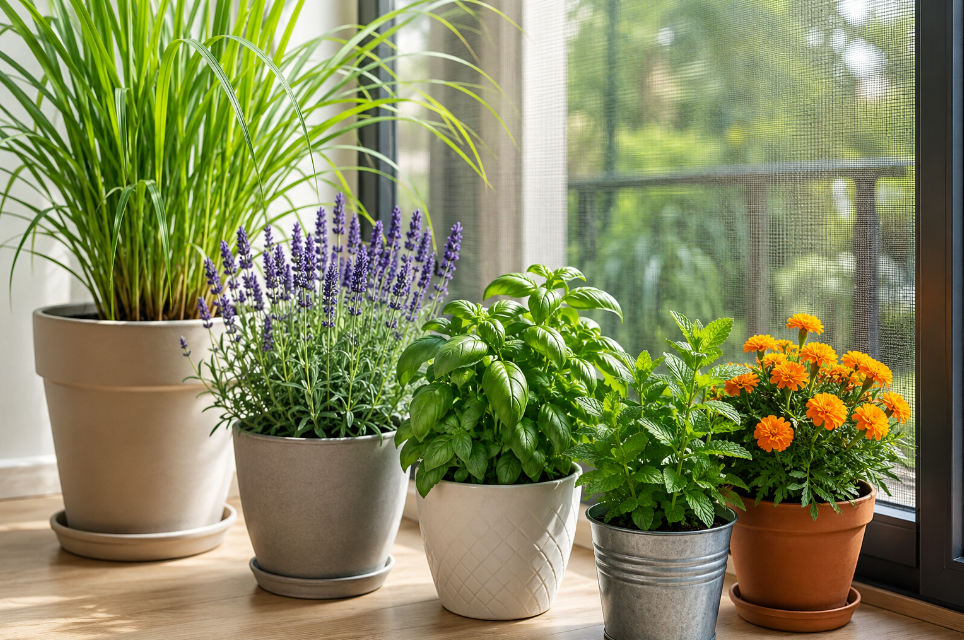
Several aromatic plants contain essential oils that have been studied for their effect on mosquitoes.
| Plant | Relevant Aromatic Compounds | Common Use |
|---|---|---|
| Citronella grass | Citronellal and geraniol | Oils, sprays, candles and outdoor products |
| Lemongrass | Citral and related compounds | Fragrant garden planting and extracted oils |
| Lavender | Linalool | Fragrance, oils and decorative planting |
| Peppermint | Menthol and aromatic oils | Extracts and short-term fragrance applications |
| Basil | Volatile plant oils | Herb gardens and experimental natural repellents |
| Lemon eucalyptus | PMD-related repellent compounds | Registered commercial repellent formulations |
The effectiveness of a finished repellent depends on its concentration, formulation, application method, mosquito species, temperature, and length of exposure.
Citronella grass and the plant commonly marketed as a “citronella geranium” are not the same.
Commercial citronella oil is generally obtained from Cymbopogon grass species. A scented geranium may have a similar fragrance, but growing it near the bed does not necessarily release enough active material to stop mosquitoes from entering or biting.
Oil of lemon eucalyptus used in registered repellent products should not be confused with homemade eucalyptus oil or leaves placed around a room.
Commercial products are formulated and labeled for a specific application. Plant leaves should not be rubbed directly onto the skin unless an appropriate product has been developed and tested for that purpose.
Mosquitoes locate people through several signals, including carbon dioxide, body heat, moisture, and skin odors.
A nearby fragrance may interfere with some odor signals for a short time, but it does not stop mosquitoes from entering through an open window, breeding in standing water, or reaching a sleeping person from another part of the room.
A fragrant plant positioned on a balcony may contribute to the atmosphere of the area, but its scent does not create a sealed protective zone.
Wind direction, room size, ventilation, and distance between the plant and the user can all reduce any local effect.
Crushing leaves may release more aromatic oil, but the amount is difficult to control. Some plant oils may also irritate the skin, eyes, or respiratory system.
A labeled repellent product should be used according to its instructions rather than replacing it with an untested homemade mixture.
Plants can be part of a garden or home environment, but mosquito prevention works better when several methods are combined.
Useful measures include:
Removing standing water from containers
Repairing window and door screens
Closing gaps around openings
Using approved personal repellents
Running a fan where practical
Installing a suitable mosquito net around the sleeping area
An Indoor Mosquito Net creates a physical barrier between mosquitoes and the sleeping area without depending on fragrance or smoke.
A net should cover the complete bed, remain free from large holes, and avoid resting directly against exposed skin. The lower edge should be secured so mosquitoes cannot enter from underneath.
Common options include:
Rectangular bed nets
Circular hanging nets
Pop-up mosquito nets
Baby crib nets
Travel mosquito nets
The suitable design depends on the bed dimensions, ceiling structure, room size, installation method, and user group.
We manufacture indoor and Outdoor Mosquito Nets, mesh fabrics, baby nets, travel nets, Tents, window screens, door screens, and related textile products.
Our factory supports customized dimensions, mesh specifications, colors, structures, accessories, labels, and packaging. Different mosquito-net designs can be developed for retailers, importers, hospitality projects, household brands, and outdoor-product distributors.
Developing a home-protection, travel, hotel, or retail mosquito-net collection?
Send us the required net shape, bed dimensions, mesh specification, fabric color, hanging structure, packaging method, and order quantity. We will prepare a suitable Indoor Mosquito Net proposal for your project.